Facebook
 X
 Pinterest
 Copy Link
Where to live in Oregon: the short answer
The best place to live in Oregon depends on the life you want around the house. Our 10 offices cover three very different Oregons: Portland’s southern edge and Yamhill County wine country, the north and central coast, and the I-5 corridor from Salem to Medford. Each one trades price, pace and weather a little differently.
Ask ten Oregonians where to live and you’ll get ten answers, plus one strong opinion about rain. So we did the next best thing and mapped out a road trip through the ten towns where our offices sit. Pack a rain jacket and sunglasses. You’ll need both, sometimes on the same day.
At every stop you’ll get three things: what everyday life feels like, the kinds of homes you’ll find, and how far you are from the nearest bigger city. For the numbers, our real estate coaches and professionals post monthly market updates and local commentary on our social media channels. You’ll find them on Instagram at @coldwellbankerpg.oregon.
Leg 1: Portland’s southern edge and Yamhill County wine country
The first four stops sit within an hour or so of Portland, but each one feels a little further from the city than the last.
West Linn: hills, trees and two rivers
Our trip starts where the Portland suburbs get hillier and the trees get taller. West Linn sits where the Tualatin River meets the Willamette, right next to Willamette Falls.
Life here: Weekends lean outdoors. Mary S. Young Park covers about 128 forested acres along the Willamette, with more than five miles of trails and a busy off-leash dog area. The historic Willamette district along Willamette Falls Drive is the place for coffee, a bakery run or a glass of wine.
Homes: Mostly single-family homes, many on wooded or sloped lots. You’ll find early 1900s houses in the Willamette Falls Neighborhood Historic District, which is listed on the National Register, alongside newer hillside homes with mountain views.
The drive: About 12 miles to downtown Portland, usually 20 to 30 minutes depending on traffic. Lake Oswego is right next door.
Newberg: where the vineyards start
Head southwest and the hills start filling in with grapevines and hazelnut orchards. Newberg is the front door to Willamette Valley wine country.
Life here: George Fox University, founded by Quakers in 1885, sits in the middle of town and keeps downtown lively. Locals have the Cameo Theatre, the Chehalem Cultural Center and a First Friday art walk close by. Champoeg State Heritage Area, about seven miles southeast, is where settlers voted to form Oregon’s provisional government in 1843.
Homes: Older bungalows near downtown and the university, newer neighborhoods on the edges of town, and acreage and vineyard properties in the Chehalem Mountains and Dundee Hills.
The drive: George Fox puts Portland at about 45 minutes away, with the coast and the mountains each about 90 minutes out. The Newberg-Dundee Bypass (Highway 18) keeps you out of the slow parts of 99W.
McMinnville: Main Street, with a very large wooden airplane
McMinnville, or Mac to locals, is the Yamhill County seat and the region’s biggest town.
Life here: Third Street is the heart of it, a walkable stretch of restaurants, tasting rooms, shops and historic hotels that Sunset magazine once named the West’s best Main Street. Linfield University has been here since the 1800s. Just east of town, the Evergreen Aviation & Space Museum is home to Howard Hughes’ Spruce Goose, and every May the town leans fully into its UFO Festival.
Homes: Historic homes near downtown and Linfield, established mid-century neighborhoods, newer subdivisions on the edges, and farms and vineyard acreage a few minutes out.
The drive: About 40 miles to Portland (roughly an hour) and about 25 miles to Salem (roughly 35 to 40 minutes).
Sheridan: small-town Yamhill County
Keep going west on Highway 18 and the valley narrows toward the Coast Range. Sheridan is the quietest stop on this leg.
Life here: The town sits along the South Yamhill River at the base of the Coast Range, with farming roots that go back to the 1840s. Sheridan has its own school district, and the big annual gathering is Sheridan Days in June.
Homes: In-town single-family homes, many of them older, plus rural acreage, small farms and hobby properties in the surrounding countryside.
The drive: About 15 minutes to McMinnville, roughly 40 minutes to Salem and about an hour west to Lincoln City on Highway 18.
Leg 2: The north and central coast
Cross the Coast Range and the light changes. Life on the coast runs on tides, fog and Highway 101, and each of our three coast towns has a different relationship with the water.
Tillamook: dairy country by the bay
We’ll start at the top of our coastal map. Tillamook sits a few miles inland on Tillamook Bay, surrounded by green pasture.
Life here: Yes, the Tillamook Creamery is here, and yes, there’s usually a line for ice cream. South of town, the Tillamook Air Museum fills a World War II blimp hangar that ranks among the largest wooden structures in the world. The 40-mile Three Capes Scenic Route links Cape Meares, Oceanside, Netarts, Cape Lookout and Pacific City.
Homes: In-town homes, farm and pasture properties in the valley, and cabins, cottages and vacation homes in nearby beach towns like Oceanside, Netarts and Rockaway Beach. A fair warning: Tillamook gets more than 90 inches of rain a year, more than twice Portland’s total. Good rain gear is part of the deal.
The drive: About 75 miles to Portland, roughly 1.5 to 2 hours on Highway 6 through the Tillamook State Forest.
Lincoln City: seven miles of beach and a lake on the side
Head south on 101 and the coast opens up into Lincoln City, one long strip of sand with a town running alongside it.
Life here: The public beach runs about seven miles, from Roads End south to Siletz Bay. From mid-October through Memorial Day, the Finders Keepers program hides handblown glass floats along it, and you get to keep the one you find. Inland, 685-acre Devils Lake drains to the ocean through the D River, which runs about 120 feet. The town also hosts big kite festivals each June and October.
Homes: Beach cottages, ocean-view homes, condos, lakefront homes on Devils Lake, and quieter in-town neighborhoods a few blocks back from the water. If you’re thinking about a second home or a vacation rental, local rules matter, and our Lincoln City office can walk you through them.
The drive: About 60 miles to Salem, roughly 1 hour 15 minutes on Highways 18 and 22, and about 2 hours to Portland.
Newport: a working harbor with a science streak
Another 25 miles south, Newport wraps around Yaquina Bay. It’s a fishing town, a science town and a beach town at the same time.
Life here: The Bayfront is home to one of Oregon’s largest commercial fishing fleets, seafood restaurants and very vocal sea lions. Across the 1936 Yaquina Bay Bridge in South Beach you’ll find the Oregon Coast Aquarium, Oregon State University’s Hatfield Marine Science Center and NOAA’s Pacific marine operations center. Nye Beach, the historic district on the north side, has galleries, cafés and the Newport Performing Arts Center.
Homes: Newport has five distinct neighborhoods along 101: Agate Beach, the Bayfront, Nye Beach, South Beach and the Deco District. That means a mix of older cottages, ocean-view homes, condos and newer neighborhoods, with more rural properties up the Yaquina River.
The drive: About 50 miles to Corvallis, roughly an hour on Highway 20, and about 1.5 hours to Salem.
Leg 3: Down the I-5 corridor, from the capital to the Rogue Valley
Back over the Coast Range, the last three stops follow I-5 south. Each one is the big city of its own region.
Salem: the capital, with a lot of green
Salem gets overlooked by people who’ve only driven past it on I-5. That’s their loss.
Life here: Downtown Salem is on the National Register of Historic Places, a few blocks from the State Capitol and Willamette University. Riverfront Park has a hand-carved carousel, and a pedestrian bridge connects it to Minto-Brown Island Park, about 1,200 acres of trails, wetlands and a large off-leash dog area. Marion County is Oregon’s largest agricultural county, so farm stands and u-pick fields are never far away.
Homes: The widest range on our trip. There are historic homes near downtown, established neighborhoods in the South Salem hills, West Salem across the river, Keizer to the north, newer subdivisions on the edges, and farmland all around.
The drive: About 47 miles to Portland, roughly an hour (longer at rush hour), and about an hour and 15 minutes to Lincoln City.
Eugene: TrackTown, with a butte in the backyard
An hour south, Eugene and Springfield share the southern end of the Willamette Valley. Eugene is Oregon’s college town, and it’s proud of it.
Life here: The University of Oregon and Hayward Field set the rhythm, which is why you’ll hear Eugene called TrackTown USA. The Ridgeline Trail system wraps the south edge of the city, topped by 2,058-foot Spencer Butte. Residents bought much of the butte in 1940 through a campaign that capped donations at $5. The Saturday Market is a year-round downtown tradition, and the McKenzie River is a short drive east.
Homes: Craftsman and mid-century homes in older neighborhoods, hillside homes in the south hills near the Ridgeline, newer subdivisions, and rural property out toward the McKenzie and Coburg. Springfield, right next door, has its own personality and price points.
The drive: Eugene is the big city for its region. Portland is about 110 miles north (roughly 2 hours), and the coast at Florence is about an hour and 15 minutes west.
Medford: Southern Oregon sunshine
The last leg climbs out of the Willamette Valley and drops into the Rogue Valley. Pack the sunglasses you didn’t need at the coast.
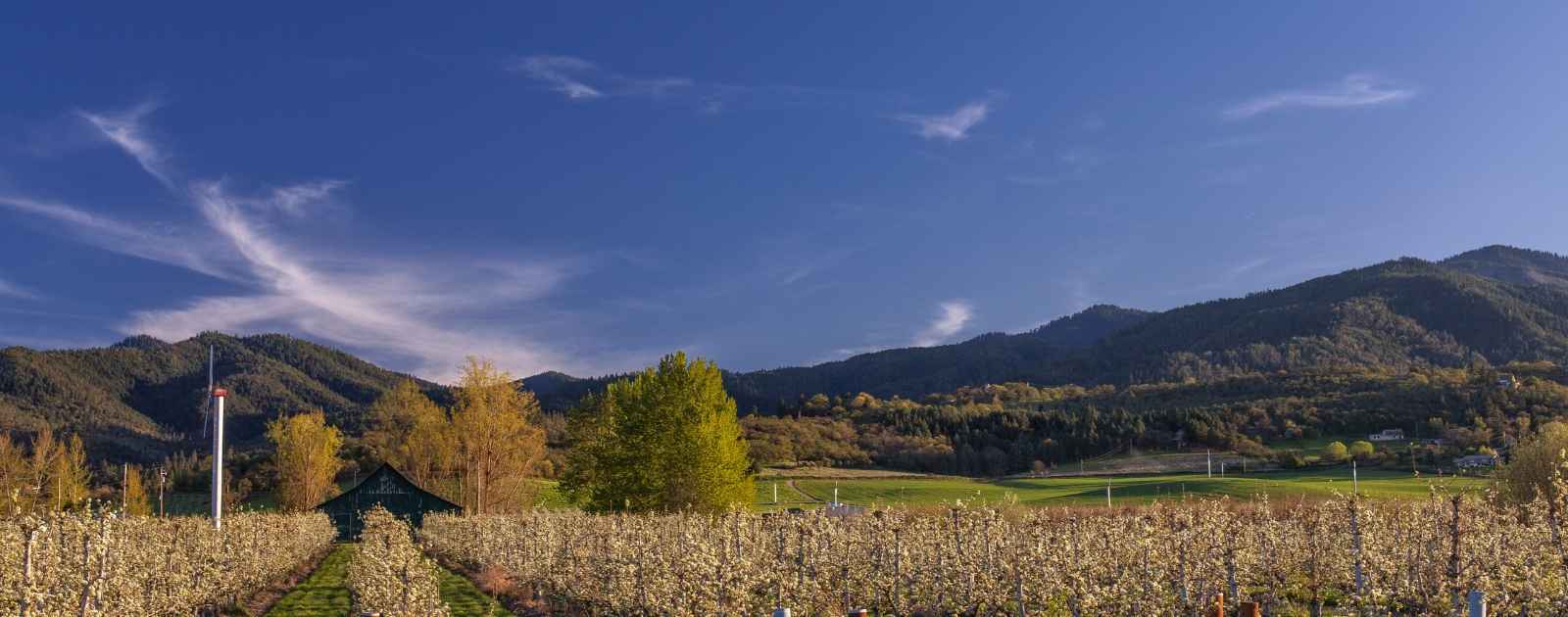
Life here: Medford is warmer, drier and sunnier than most of western Oregon. The Rogue Valley is known for pear orchards, vineyards and rafting on the Rogue River, and the Table Rocks are the local hikes everyone mentions first. Ashland and the Oregon Shakespeare Festival are 15 to 20 minutes south, and Crater Lake National Park is about an hour and a half up Highway 62.
Homes: Established neighborhoods near downtown and in east Medford, newer subdivisions, nearby towns like Central Point, Jacksonville and Eagle Point, and rural acreage, orchards and vineyard land across the valley. Wildfire risk and insurance are part of the conversation here, so it’s worth asking about both early in your search.
The drive: Medford is the hub of Southern Oregon, with its own airport, Rogue Valley International-Medford. Eugene is about 170 miles north (roughly 2.5 to 3 hours), and Portland is about 4.5 hours.